
A Power Control Panel is more than a cabinet of breakers and wires. It is the point where electrical design meets daily operating conditions. Global buyers must compare rated voltage, frequency, load capacity, short-circuit withstand, enclosure protection, and control functions. A mismatch may look minor on a quotation. It can create costly delays during installation.
Electrical engineering pioneer Nikola Tesla wrote, “The desire that guides me in all I do is the desire to harness the forces of nature to the service of mankind.” His words express a useful design principle, though they are not a panel-buying rule. For buyers, that principle means asking how a panel will perform in its actual environment: a dusty workshop, a humid processing room, or a hot utility space. Details matter. So does documentation.
This guide presents ten practical buying tips for global projects, from defining loads and checking component quality to reviewing testing records, drawings, spare parts, and supplier support. Request clear evidence for ratings and certifications relevant to the destination market; do not rely on vague claims in a brochure. Ask who will handle commissioning questions after delivery. One detail is easy to overlook: matching the panel’s design to future expansion, not only today’s load. Still, no checklist removes every risk. Project specifications can be incomplete, and buyers sometimes approve them too quickly. A careful review may feel slow. It is often cheaper than correcting a panel after it arrives.
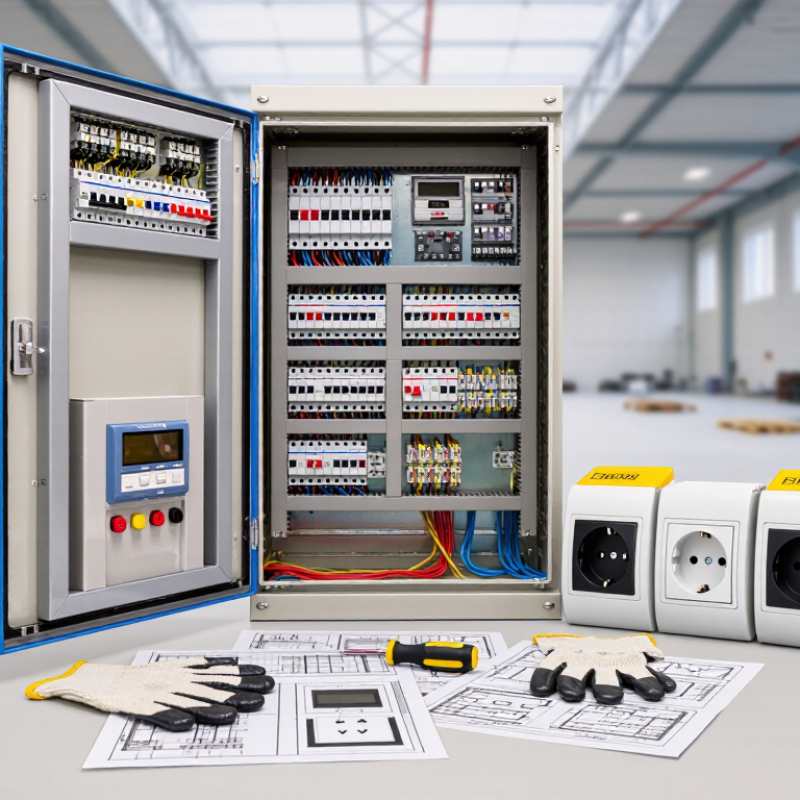
For a power control panel, specify the supply voltage, phase, and frequency before comparing quotations. IEC 61439 covers low-voltage assemblies with rated voltage up to 1,000 V AC. This is a scope limit, not a recommended operating target or proof that a particular panel suits your site. State the actual system voltage, such as 400 V three-phase, and ask the supplier to confirm the assembly’s rated voltage and applicable verification documents.
Define current at both the incoming supply and individual circuits. For example, record the expected continuous load, motor starting conditions, and any planned expansion. Also provide the prospective short-circuit current at the installation point; a 400 A rating alone says little about fault withstand capability. Ambient heat matters, too. A panel in a warm plant room may need different design consideration from one in a cool, ventilated space. A tidy load spreadsheet can still miss a future pump or an unusual duty cycle.
Tip: Send a one-line diagram, load schedule, and site conditions with your inquiry. Ask for rated current, short-circuit withstand, and temperature assumptions in writing. Check that the stated values match the intended installation. Small details get overlooked, sometimes even in a polished specification. Have the responsible electrical designer review any unclear ratings before purchase.

When buying a power control panel, match its IP rating to the actual dust and water exposure. IEC 60529 defines the IP code: the first digit, 5, means dust ingress is limited, but the enclosure is not dust-tight. Ingress must not impair operation or safety. The second digit, 4, indicates protection against water splashes from any direction. Not immersion. Not pressure washing.
For an indoor production area with airborne dust and occasional splashes, IP54 may be appropriate. Check that the rating applies to the assembled panel, including cable glands, door seals, display cutouts, and ventilation openings. A strong enclosure can lose protection through one poorly sealed entry. One easy-to-miss detail: ask for the IEC 60529 test documentation, not just an IP54 label on a product sheet. Also compare the test setup with your installation; open doors or added cable entries can change protection. This is not always straightforward, and a higher rating alone does not guarantee a better fit. If regular hose cleaning is expected, reassess the specification rather than assuming IP54 is enough.
A panel’s short-circuit rating must be checked against the fault current available at its installation point, not chosen from load size alone. Ask the site engineer or utility for the prospective fault-current value at the panel terminals. Transformer capacity and impedance, cable length, and generator operation can all change that figure. Small details matter.
Check the assembly’s short-circuit current rating at the specified system voltage. Then confirm that the upstream protective device and its exact type and settings match the conditions used to establish that rating. A component’s individual rating does not automatically prove the complete panel is suitable. Request the supporting test or engineering documentation, and compare it with the site fault-current study. Keep the figures together. It saves time later.
I have seen purchasing schedules list a rating without stating the voltage or protective-device conditions. That is easy to overlook, and frankly, it is not enough. If the available fault current is higher than the assembly rating, pause procurement and ask a qualified engineer to review the design. Do not assume a larger breaker solves the mismatch. Verify the final configuration before approval; small field changes can matter.
| Tip | What to Verify | Evidence to Request | Buying Check |
|---|---|---|---|
| 1. Obtain the site’s available fault current | Confirm the prospective short-circuit current at the panel’s installation point, for the specified supply voltage and configuration. | A current utility fault-current letter or a qualified engineer’s short-circuit study, including the calculation location and assumptions. | Do not rely on a site-wide estimate if the value at the actual panel location is available. |
| 2. Match the rating to the system voltage | Check the assembly short-circuit rating at the actual system voltage. A rating stated at one voltage should not be assumed to apply at another. | The panel nameplate and supporting rating documentation showing the applicable voltage and short-circuit rating. | Compare ratings and fault-current values on a consistent voltage basis. |
| 3. Check the complete assembly rating | Verify the short-circuit current rating (SCCR) or applicable assembly short-circuit withstand rating for the assembled panel, not just for an individual component. | Assembly-level documentation and the rating marked on the panel, with the applicable conditions of use. | The assembly rating must be suitable for the site’s available fault current at the installation point. |
| 4. Distinguish SCCR from interrupting rating | An overcurrent protective device’s interrupting rating and the panel assembly’s SCCR are related but different ratings. | Device ratings plus the assembly’s documented SCCR or short-circuit withstand rating. | Confirm both the protective device and the complete assembly are suitable for their respective duties. |
| 5. Review the lowest-rated components and combinations | A panel rating may depend on component ratings, wiring, construction, and tested combinations. A component’s standalone rating does not automatically establish the assembly rating. | The manufacturer’s rating method, component schedule, and any required combination or installation details. | Check that the delivered configuration matches the documented configuration. |
| 6. Validate any series-rated or tested combination | If a higher rating relies on an upstream protective device or a specific tested combination, verify that the exact arrangement is permitted and documented. | The applicable coordination or combination documentation, including device types, ratings, and required upstream protection. | Do not substitute devices or change the arrangement without confirming the rating remains valid. |
| 7. Confirm upstream protection and coordination assumptions | Check whether the assembly rating or protection strategy depends on a particular upstream fuse or circuit breaker, and whether the site design provides it. | Protection study or coordination documentation identifying the required protective devices and settings, where applicable. | Make required upstream protection part of the project specification and installation review. |
| 8. Check the fault-current study assumptions | Available fault current depends on the source and system configuration. Changes to transformers, generators, parallel sources, or conductors can affect the calculated value. | Study inputs such as source data, transformer impedance, conductor details, and operating configuration. | Ask for the study to be updated if the design or supply arrangement changes. |
| 9. Confirm the governing standards and approval route | Applicable requirements vary by country, project specification, and authority having jurisdiction. Examples include IEC 61439 for low-voltage switchgear and controlgear assemblies and, where applicable, UL 508A requirements for industrial control panels. | Applicable standards, conformity or certification documents, and any required local approvals. | Agree on the governing standard and approval requirements before placing the order. |
| 10. Make rating and installation details traceable | Ensure the delivered panel is identifiable and its short-circuit rating, voltage, and any conditions of use can be checked during installation and inspection. | Nameplate details, drawings, bill of materials, and rating documentation tied to the supplied panel configuration. | Resolve any mismatch between the approved documents and delivered equipment before energization. |
Final equipment selection should be reviewed by a qualified electrical professional against the project’s current fault-current study and local requirements.
For a U.S. installation, ask for a UL 508A industrial control panel and its marked short-circuit current rating (SCCR). Under UL 508A Supplement SB, the panel’s SCCR is determined using specified component ratings and permitted combinations. Compare it with the available fault current at the installation point; a higher rating is not automatically safer or necessary. Request the calculation, nameplate details, and component documentation, not just a catalogue value. Small details matter.
Check the destination market before approving the design. Canadian projects may require evaluation to applicable Canadian standards, while European projects need the relevant conformity assessment and technical documentation for applicable requirements. IEC 60204-1 may apply to machinery electrical equipment; it is not a universal substitute for every panel requirement. Ask the local engineer or inspection body to confirm the route. Requirements differ. A certificate accepted in one country may not settle acceptance elsewhere.
This diligence is practical, not paperwork for its own sake. NFPA’s analysis of U.S. industrial and manufacturing fires from 2011–2015 estimated 37,910 fires annually, with $1.2 billion in direct property damage. The figures cover many fire causes; they do not prove that control panels caused them. Still, they show why buyers should verify protection and documentation. Review SCCR against site fault-current data, then confirm certification scope, labels, drawings, and language for each market. I have seen buyers leave this check until shipment. That is an avoidable, expensive pause.
10 Power Control Panel Buying Tips for Global Buyers
Require IEC 61439 Routine Verification for Every Completed Assembly
When comparing power control panels, ask for routine verification records for every completed assembly, not just a sample unit. IEC 61439 sets requirements for low-voltage switchgear and controlgear assemblies, including checks on construction and performance. These checks help confirm that the finished panel matches its verified design. A design certificate alone does not show that each delivered assembly was inspected and tested.
Request records linked to the panel’s serial number. They should identify the checks performed, results, test equipment, and any corrective work. Relevant checks include protective-circuit continuity, clearances, mechanical operation, wiring, and dielectric properties. Ask who performed the verification and whether the equipment was suitable for the test. Small details matter.
Demand for reliable electrical equipment is rising. The International Energy Agency’s Electricity 2024 report states that global electricity demand grew by 2.2% in 2023 and forecasts average annual growth of 3.4% from 2024 to 2026. More connected equipment makes consistent inspection important. Still, paperwork can create false confidence if records are copied forward or lack assembly-specific results. Review a sample report before ordering, and clarify how failed checks are documented and resolved.